

Thebes Antiquities of Luxor – Luxor Temple
The credit for building this temple in its current form on the eastern bank of the Nile on one axis from north to south is attributed to King Amenhotep III of the eighteenth dynasty. King Ramses II of the nineteenth dynasty added a large edifice and a spacious courtyard with papyrus slabs. The first core of this temple was laid in the Middle Kingdom.
Amenhotep III ordered the erection of this temple to the Theban Trinity; Most likely two things:
The first is to confirm a relation to the god Amun himself since his entitlement to the throne was not clear according to the Egyptian traditions, which stipulate that the king must be the son of a king and from a royal dynasty; But if the lineage is impure, then he acquires his entitlement to the throne by marrying the eldest daughter of the (former) king. One of the two conditions did not apply to Amenhotep III. He was appointed by “Mutt-um-Oya”, who was not an Egyptian, but rather a Mittan lady, the daughter of “Artatama” king of the Mitanni state, and she was not his wife. “T” of a royal dynasty, but was a lady of the common people. For this reason, Amenhotep thought that he should confirm his legitimacy to the throne by proving his lineage to the god Amun himself, as Hatshepsut had done before; His thinking led him, “after consulting the priests of Amun,” to record his holy birth on the walls of the famous room in the temple known as the birth room. The result of this was that Amenhotep III, who is known not to be of an Egyptian royal dynasty, became better than the previous kings of Egypt who had pure royal blood in their veins because he became the son of the god Amun Ra directly; From his crucifixion and with this legend and this theory, Amenhotep III confirmed his right to the throne. The second matter is to please the priests of Amun to accept him as the legitimate king of Egypt, despite the lack of clarity of his entitlement to the throne. The priests of Amun could not reject the lineage of Amenhotep III to the god Amun; He promised them to establish a large temple to announce the great Amun, and for this reason, the priests accepted the new king by his divine lineage. The people who did not doubt anything accepted by the priests did not reject him.
The god Amun visited his wife, the goddess Mutt, once a year, so he moved from his temple in Karnak to the Luxor temple. That is why they made the house of Karnak the official palace of Amun and the house of Luxor his private home for his wives to live in. But he does not move to that house in his official procession except on a special date during the year. And it is the date of his marriage, which the people made in the month of “Bab”, which was called by the name of the house itself. They did not choose for the throne of Amun that date, either spontaneously or spontaneously, but rather they chose it after a deep thought stemming from the love of life and the hope of enjoying its good. In this month, it is the flood season, which is the season of fertility and blessing, in which the river is planted in the land of Egypt, so it brings with this great good that comes to the world good sustenance on which the children of life in this valley live; If the people made the marriage of their Lord “Amun” in this month of the year, then this means that they were only seeking for him and for themselves good and blessing at the time of goodness and blessing, and wishing him fertility in his married life to provide them with his fertility and to shower them with his righteousness and mercy. This is one of the colours of human thought that stems from the love of survival and security in life and the search for the doors of sustenance from its doors. Thus, the Egyptians thought of marrying their Lord “Amun”, and then they celebrated the anniversary of that marriage if the flood season came every year.
The Egyptians called this temple “Abit Rast”, meaning “Abet” in the south. Specialists differed in the meaning of the word “Abit”, and most of them believe that the word “Abit” means “harem” and that “Interest” means the southern harem because of the procession of the sacred god travels by the Nile. From the Temple of Karnak to the Temple of Luxor, i.e. from north to south, that is why specialists believe that it was during the period that Amon spent in Luxor, which was eleven days in the eighteenth dynasty and reached twenty-three days in the nineteenth dynasty and increased to twenty-seven days in The twentieth dynasty and that a sacred marriage (or a celebration of the anniversary of the sacred marriage) was taking place between the god Amun and the goddess Mut, and for this reason the Luxor Temple was considered as a “wedding palace” in which the anniversary of this sacred wedding is celebrated every year.
Imhotep III, his engineer, “Amenhotep Ibn Habu”, ordered the construction of a group of buildings, which most likely started from the south, where the Temple of the Middle Kingdom was erected in the Holy of Holies, because the main objective of establishing any temple is to find the right place for the statue of the god first, and then build the necessary set of stores around it, and finish it In the grandiose corridor, which consists of two rows of arches that end with crowns in the form of an unfolding papyrus flower. The work on this great corridor was not finished in his life. When his son Amenhotep IV “Akhenaten”, came to the country’s throne, he left Amun and worshipped the god Aten and even traced the name of Amun and erased it from his father’s inscriptions temple, then Tutankhamun and after him, Horemheb completed this great corridor.
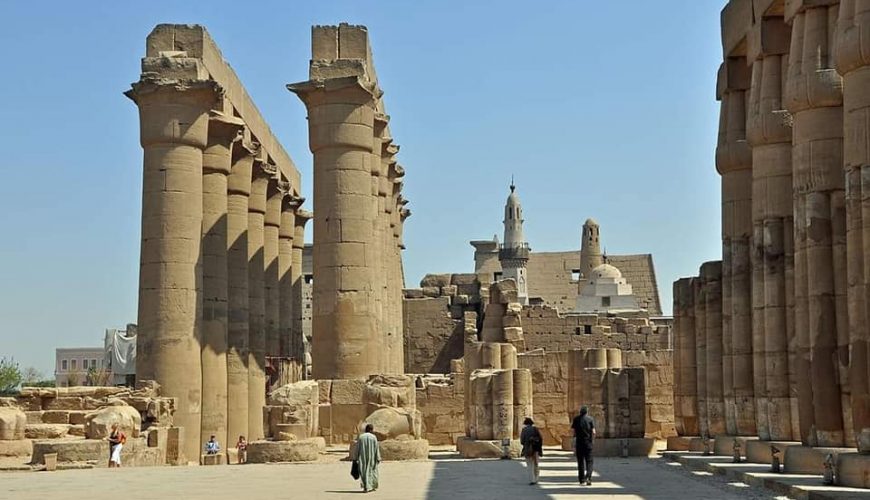
In the nineteenth dynasty, Ramses II ordered his architect, “Bak-en-Khonsu”, to add the large open courtyard with two pillars and erect a huge edifice and six statues of King Ramses II and two obelisks in front of it. Christians also built a church in one of its southern parts, and Muslims built a mosque during the Fatimid era, which is the mosque of Sidi Youssef Abi Al-Hajjaj. We see him to the left of the interior directly in the courtyard of Ramses II.
The Arabs called this temple “Luxor” when they saw these huge facilities that resemble their palaces, as evidenced by the presence of a palace name in the names of many temples dating back to the period of the rule of the Ptolemies or the Romans in Egypt, such as Ibrim Palace in Nubia and Qasr Al Banat in northwest Fayoum. The older man’s palace in Habu and Qasr Qarun are Arabic names that the Arabs gave to these temples when they saw them.
Temple Description:
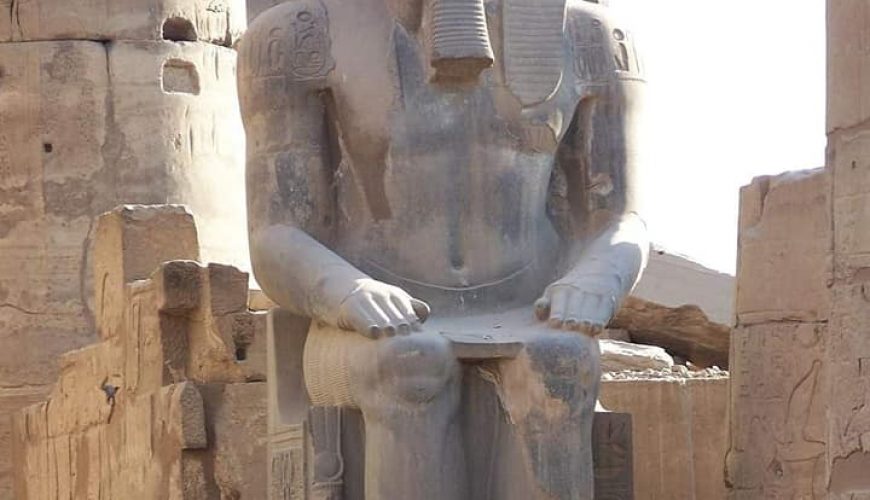
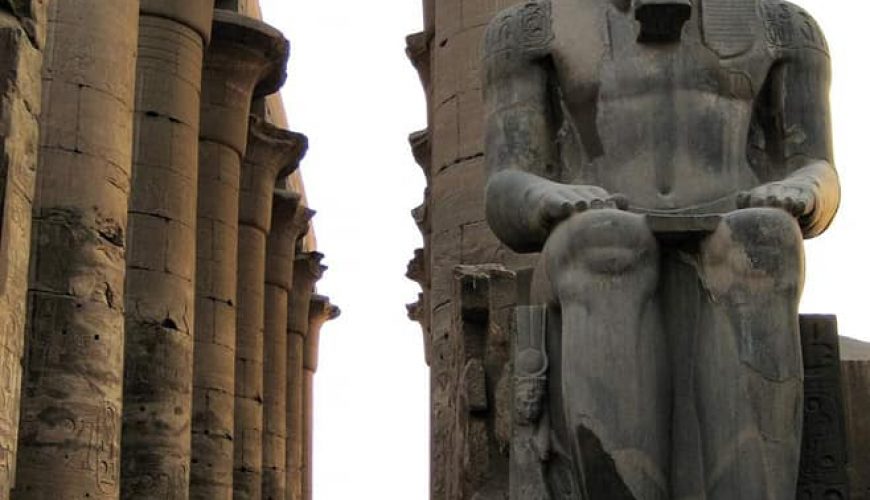
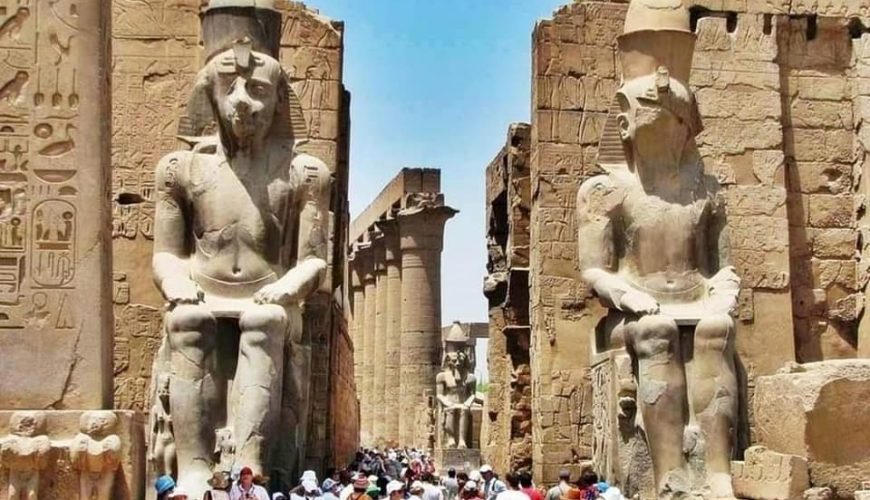
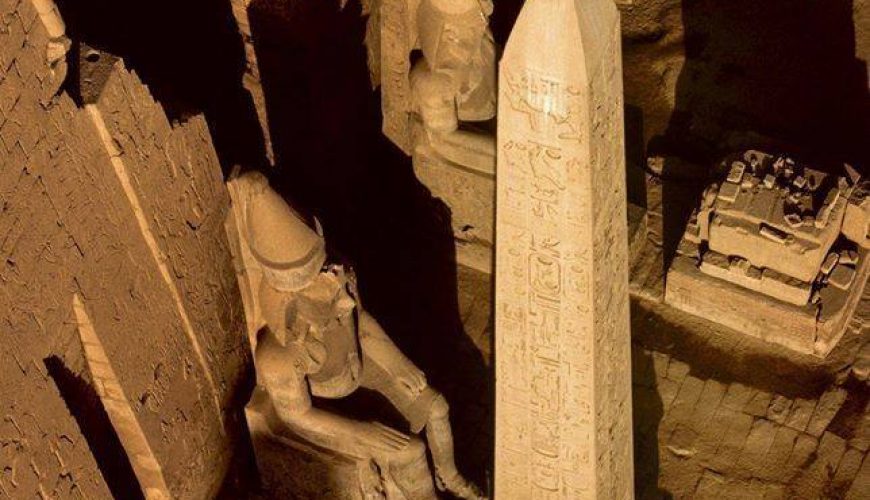
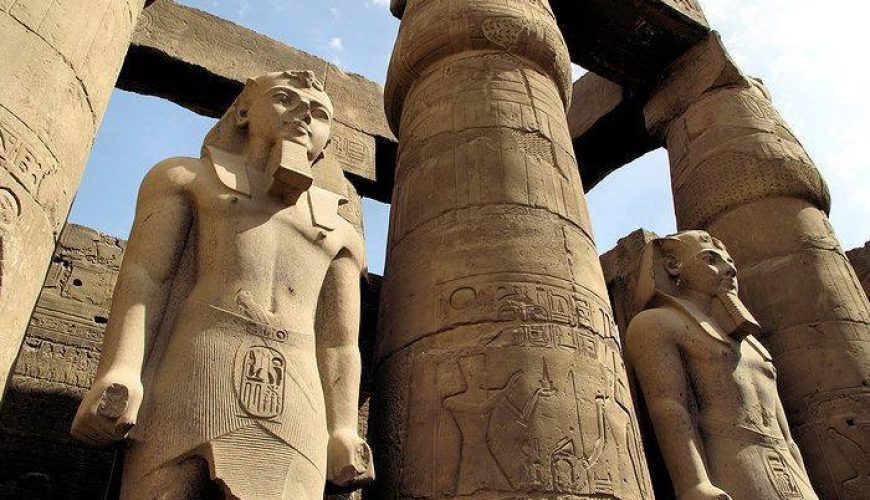
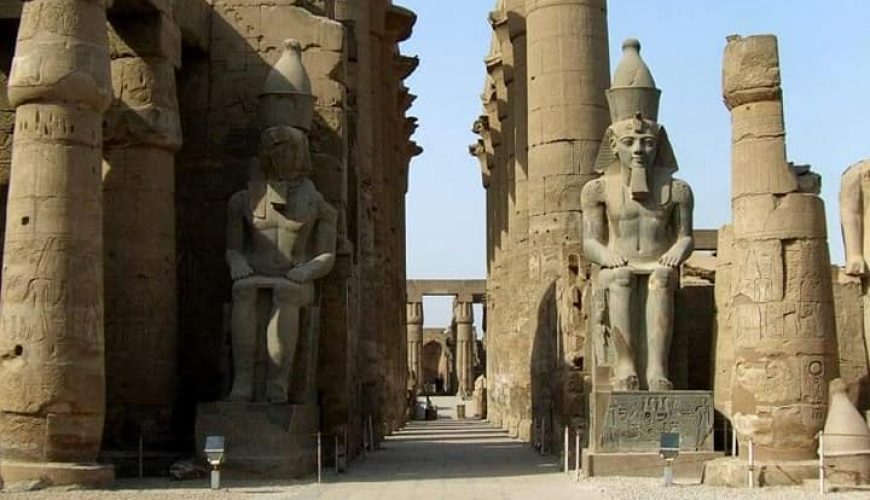
We come now to the edifice of the temple, which was built by Ramses II, which is a huge gate, in the middle of which is the entrance to the temple, and was preceded by six huge statues of him; Two large statues on either side of the entrance represent Ramses II while he was sitting, and next to each were two other statues representing him standing. Only two seated statues remain, each of which is 14 meters high, and one standing statue is located on the far right (about the interior). Ramses II also erected two obelisks of pink granite in front of the edifice adorning the smaller of them on the Place de la Concorde in Paris since 1836. It reaches a height of 22.2 meters. The other one has remained standing until now in front of the northern tower (relative to the interior) and is characterized by a group of prominent monkeys that cheer the sun and are carved on its base. The height of this example reaches 24.6 meters. In front of the edifice, there is also a road for the Sphinx dating back to King Nectanebo, one of the kings of the Thirtieth Dynasty that used to lead to the temple of Khonsu south of the Karnak temples.
The inscriptions on the edifice’s facade (approximately 65 meters wide) describe the military battles that Ramses II carried out against the Hittites in the fifth year of his reign, and they are unfortunately largely destroyed. We see on the right (western) wing of King Ramses II’s edifice and his military advisory (the view is engraved in Aqsa left). In the centre, we see the site or camp in which he defeated his enemies from the Hittites, and in the far right, we see the king in his chariot in the middle of the battle. The scenes represented on the left (eastern) wing of the edifice represent Ramses II in his chariot, throwing the Hittite enemies with a barrage of arrows. The land is covered with dead and wounded. As for the living, they flee in panic and leave Kadesh. In the far north on this wing is a view of the frightened Prince of Kadesh in his chariot. A complete description of this battle was written in the ancient Egyptian language (in the hieroglyphic inscription) in a poetic style. It is also found on the lower part of this edifice. The text starts from the western (right) wing and ends on the eastern wing.
There are also four vertical slots on the facade of the edifice, two in each wing, which was designated for placing the flagpoles. There are also four slots at the top of the edifice designated for installing these flagpoles. On both sides of the entrance from the outside, we see scenes representing King Ramses II in his various relations with the gods and goddesses; we mention of them the holy trinity of Thebes, in addition to the gods Amunt. As for the shoulders of the entrance from the inside, additions are dating back to the twenty-fifth dynasty representing King Shabaka in his different relationshirelationshipsAmun Wamont, Mento and Hathor.
As for behind the left-wing of the eastern edifice, there are various beautiful scenes of King Ramses II and his wife in the presence of the gods and goddesses and participate in the celebration of the feast of God Min.
We arrive from the entrance to the edifice to the spacious courtyard (57 meters wide and 51 meters long), which Ramses II built. It is surrounded by features whose roof is based on two rows of arches, except for the building built by Hatshepsut and Tuthmosis III, which is located directly to the right of the interior. These two pillars formed (74 pillars). ) in the form of the papyrus plant, and it actually depicts the deterioration of architectural art in the nineteenth dynasty. The slates of Ramses II have lost all the resemblance to the original form that they are supposed to represent, especially if we compare them with the slates of Amenhotep III in the same temple and between the beautiful and graceful granite slates erected and Tuthmosis during the reign of Hatshepsut The third and standing in front of the three chapels of the Holy Trinity in the northwestern part of the courtyard of Ramses II himself. There are statues of King Ramses II between the front slates in the southern half of this open courtyard, some of which represent him standing and others sitting. On both sides of the entrance leading to the great corridor erected by Amenhotep III, we see two huge statues representing Ramses II sitting on the throne, which was decorated with scenes representing the Nile God. They confirm the unity between the two faces by linking the papyrus girls, the symbol of the north, and the lotus plant, the symbol of the south. The statues of Ramses II located on the eastern side are distinguished from The courtyard is beautiful and elegant. It also distinguishes some of them; Whether it is represented by sitting or standing, and the presence of Queen Nefertari in a small size, engraved or carved like a statue near one of the legs of the statue. This courtyard was called the “Temple of Ramesses United Forever”.
The walls of the spacious courtyard are decorated with various scenes representing the sacred offerings, besides scenes representing the defeated foreign peoples. The most important scene that must be seen in the courtyard is the view on the southwestern wall. The view represents the entire facade of the Luxor Temple, i.e. the edifice with its six statues, flags, and two figures; To the right of the (Nazir) we see a procession led by the princes from the sons of Ramses II, followed by a fat, decorated sacrifice of cattle that will be sacrificed – most likely as an offering.
In the northwest corner of the courtyard of Ramses II, there are the three chapels built by Hatshepsut and Thutmose III. However, some believe that Ramses II, whose name was recorded on them, was the one who erected them with stones; he raped them from the chapels of Hatshepsut and Thutmose III. The red; as for the crowns of these two legends, they are the papyrus stems, and they have been pulled to each other. It is noted that there is a ligament with five coils under the crown. We can call them idiomatically the budded papyrus crowns to distinguish them from the open papyrus crowns. The god Khonsu, the god of the moon. Each of the three cabins was characterized by scenes representing the firing of incense, purification, the offering of fat, and the sacrifice to the sacred boat of the god and deities that owns this cabin, in addition to the various religious scenes. As for the Abu Al-Hajjaj Mosque, it occupies the northeastern part of the courtyard.
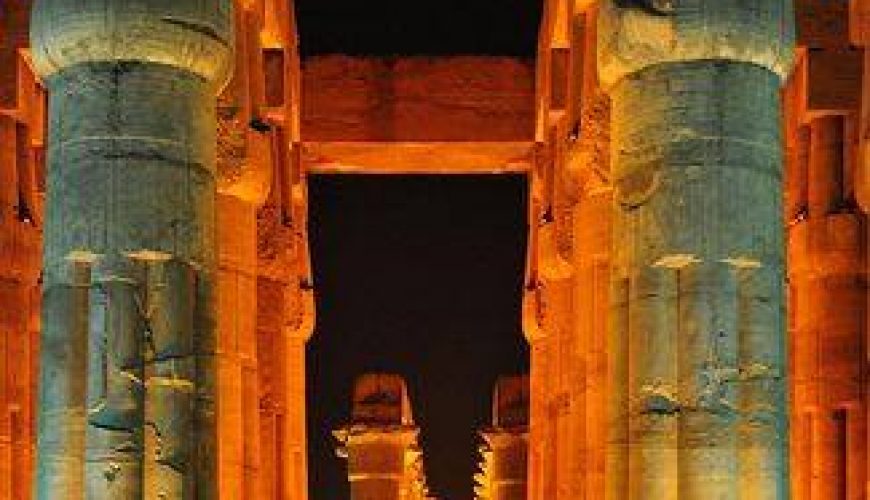
Following the courtyard of Ramses II are the remains of the edifice that represented the entrance to the temple during the reign of King Amenhotep III. After that, we reach the grandiose corridor that consists of two rows of great papyrus slabs; In each row, seven cylinders end with crowns in the form of an open papyrus flower. The height of the cylinders reaches 16 meters, and there are still some huge blocks that carried the roof of this corridor.
On the walls of this corridor were also recorded the celebrations of the feast of “Apet” or “Opet”, which most likely dates back to the reign of King Tutankhamun, and it depicts the annual celebrations that take place in the Nile when Amun-Ra, the god of Karnak, visits the Luxor temple. The huge, whose front and rear distinguish the head of the ram representing the god Amun. As for the boat of death, it is decorated with the head of a woman, above each of them an ornament for the head in the form of an eagle. Perhaps the reason for this is that the word death in the ancient Egyptian language is written with the sign of the eagle. The third boat is the boat of the son of Khonsu with the heads of the falcon, and he used to accompany these boats Priests, dancers, musicians, soldiers, flag bearers, and various groups of people.
The views of the procession start from the northernmost part of the western wall and then continue in the south to its end, and then continue from the northernmost part of the eastern wall until its end, but most of the scenes have been damaged.
The scenes of the procession on the western wall can be traced from north to south as follows:
1- Royal offerings in front of the boats of the Holy Trinity in the Temple of Amun in Karnak.
2- Carrying the boats of the gods on the shoulders of the priests from Karnak to the Nile River.
3- The boats sail on the Nile to the Luxor Temple in a great religious and popular celebration.
4 – The procession of land boats (from where they docked in the Nile) to Luxor Temple.
5- Views of sacred boats, offerings and offerings inside Luxor Temple.
On the eastern walls, we follow the views from south to north as follows:
1- Royal offerings in front of the boats of the Holy Trinity in Luxor Temple.
2- Carrying the boats of the gods on the shoulders of the priests from Luxor Temple to the Nile.
3- Sailboats in the Nile to return to Karnak in a great religious and popular celebration.
4- The procession of land boats (from where they docked in the Nile to the Temple of Amun in Karnak.
5- Royal offerings and offerings in front of the sacred boats in the Temple of Amun in Karnak.
With his intelligence, Hor Moheb was crowned in Thebes on the “Opt” festival. Also, Seti I, Ramses II, and Seti II recorded their names on the walls of this great corridor. We now reach the great courtyard built by Amenhotep III, 51 meters wide and 45 meters long. It was dedicated to religious ceremonies in which different groups of people participate. On its eastern, western and southern three sides, two rows of papyrus were erected in the form of bundles of papyrus stems, totalling 64 stones. Most of the ceiling on which the lintels rested on the pillars have fallen, so we cannot see the bright light and the existing shadow for which this courtyard was designed in this dark way, for which this courtyard was designed in this way to show it. As for the views of this courtyard, most of them have been destroyed. At the beginning of 1989 AD, a group of statues representing kings and lords was found during excavations in the southwestern part of this courtyard. A hole was dug in the courtyard to find out why the displacement of some columns and lintels threatened the temple and visitors. The excavations resulted in discovering a pit in the ground, which contained 26 statues representing kings, queens and lords in a good state of preservation. The nine most important pieces of art from this collection are now on display at the Luxor Museum.
Behind the ceremonial court, we find the legends’ hall. It includes four rows of papyrus buds formed in the form of bundles of budded papyrus stems. Each row has four legends, and it can be considered a hall for the manifestation of God and for the radiance, where the (statue) of God appears when leaving the Holy of Holies. The top is a few scenes that can be traced from the lower part of this hall’s eastern and southern wall, where we see scenes of the different regions of Egypt represented by the Nile god carrying offerings and offerings. These offerings may indicate the products of the regions. We also see on the eastern wall a scene representing Amenhotep III in front of the good gods. Seti I, Ramses II, Ramses III, Ramses IV, and Ramses VI recorded their names on some of the masters and walls of this hall.
In the southern wall of the masters’ hall, on the right and left of the interior, we find two small entrances that lead to two small shrines, the right representing the western and left cabins of the god Khonsu, adjacent to the eight-room hall of the goddess Mut, adjacent to the eastern cabin of Khonsu. We also find an entrance to a destroyed staircase near the western Khonsu shrine. In the middle of the southern wall of the Hall of Legends, we find a simple staircase that leads to a hall that had eight masters. It was removed when it was transformed in the Roman era (from 30 BC to 395 AD) into a Christian temple. The entrance leading to the Holy of Holies was closed and turned into a cavity (apse) erected on each of the sides of a column . . . . . . . . . . . . . . . . . . . . . . . . . . . . . . . . . . . . . . . . . . . . . . . . . . . . . . . . . . . . . . . . . . The beautiful scenes of Amenhotep III, who is in a different relationship with the gods and goddesses, were covered with a thick layer of white to draw Christian religious scenes on them. Over time, part of the layer of whiteness peeled off, resulting in the scenes below representing King Amenhotep III in different religious scenes. It is believed that this hall is part of The Transfiguration Hall, according to the scenes in it that indicate that. Perhaps the most important of these scenes is what we see on the eastern part of the southern wall, where we see the king kneeling before Amun and the god Death with the head of a lioness heading. We also find in this hall two small rooms, one to the right at the end of the western wall and the second to the north at the end of the eastern wall.
After that, we arrive from the entrance that worked in the cavity to a hall with four pillars that was dedicated to the table of offerings and sacred offerings, as more than forty scenes were engraved on its walls representing King Amenhotep III and the offerings and sacred gifts he offers to Amun. Among them, we mention the list of offerings offered by the king to the temple’s god.
As well as the four calves presented by Amun, and we see them on the northern wall to the left of the interior directly. Many scenes represent the king on the eastern wall as he releases incense and presents pots and boxes of coloured clothes and other offerings to Amun. In the western wall of the offering table hall, we find an entrance that connects to many rooms. We also find another entrance in the middle of the southern walls, and it reaches the room of the sacred boat of Amun, which is the cabin built by Amenhotep III on the basis that it is on a straight axis with the entrance to the temple. The cabin of the sacred boat here is surrounded by many rooms that may have been used as stores for keeping the things necessary for the daily service in the temple, such as utensils, incense burners, oils, perfumes, incense, clothes and the like. The various scenes representing King Amenhotep III in his relations with the gods and goddesses were depicted on the walls of this cabin. Various from flowers, incense, and four calves to Amun.
The ceiling of this room was carried by four pillars, which were removed when Alexander the Great wanted (in 332 BC. AD) to establish a sacred shrine for the sacred boat of the god Amun, so he set it in the middle of this room built by Amenhotep III. Alexander in his various relations with the Theban Trinity. Perhaps one of the most important external scenes is the view that represents the different stages of entering the temple. This should be noted the vast difference between the delicacy and beauty of art during the reign of Amenhotep III and its exaggeration and its distance from beauty during the reign of Alexander.
In the eastern wall of the Sacred Boat Chamber, we find an entrance that leads to a side room with three pillars, with an entrance in its northern wall that leads to another room with three pillars that has its historical fame. It is the room known by convention as the birth room, and it was known by this name because of the scenes representing the birth of Amenhotep . . . . . . . . . . . . . . . . . . . . . . . . . . . . . . . . . . . . . . . . . . . . . . . . . . . . . . . . . . . . . . . . . . . . . . . The third, divine, is the recording in which Amenhotep III wanted to confirm his lineage with the god Amun himself, as we know that his father, Thutmose IV, had married a Mittan princess, the death of the mother of Uya, the daughter of the Mitanni king, Artatama, and as we know a foreign princess whose blood does not flow in her veins . . . . . . . . . . . . . . . . . . . . . . . . . . . . . . . . . . . . . . . . . . . . . . . . . . . . . . . . . . . . . . The Egyptian royal and for this the king wanted to confirm his legitimacy to the throne by proving his lineage to the god Amun himself, as did Queen Hatshepsut before him. We must not forget that this birth room was one of the main reasons for building the entire Luxor temple.
The scenes engraved on the western wall represent three rows representing the holy birth with the help of gods and goddesses. As for the scenes on the southern wall, they represent the ascension of Amenhotep III to the throne. In any case, the scenes are mostly broken and lost large parts them. Perhaps one of the most important scenes is the representation of the god Thoth leading Amon to the queen’s chamber to replace Thutmose IV and the scene of the god Amun and the king “Mutt Umm Uya” while sitting on a bed carried by the two goddesses Selt and Nate. It resembles the sign of the Egyptian sky, and finally, a view. The god Khnum makes two children on the al-Fakhrani wheel, Amenhotep and his consort (the Ka).
We arrive from an entrance in the southern wall of the boat cabin to a hall with ten barrels divided into two rows, which, according to the scenes it contains, may have been dedicated to the sacrificial table of the statue of the god in the Holy of Holies, which was residing in the middle room immediately following it, which is a room with four pillars divided into two rows. The scenes on its walls represent Amenhotep III in his various relations with the gods, along with the scenes that represent his offering of the two boats to them. On both sides of the statue’s room, there are a group of rooms that were most likely dedicated to the ritual supplies of the deity’s statue. As for the external views of the western wall and the eastern wall of the temple, it was represented by the Asian wars of King Ramses II. After the additions of Ramses II, the length of the Luxor Temple is 255.9 meters, and it was approximately 190 meters during the reign of Amenhotep III. It reaches 54.4 meters at its maximum width.
Copied from archaeological professor Mohamed Hussein

Comment (0)