
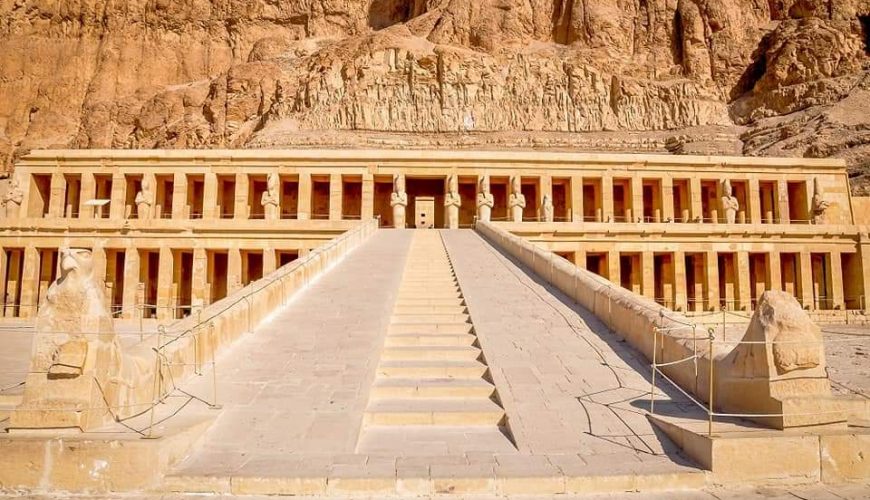
Hatshepsut Temple / Luxor
The mortuary temple of Queen Hatshepsut, who is one of the greatest queens of Egypt throughout history.
The temple was built and designed by the engineer Senmut in the ninth year of the queen’s reign, and he used good limestone in its construction.
The temple was built on large flats resembling balconies, one above the other.
Temple Components:-
The ascending road that contains statues of the Queen in the form of the Sphinx
On both sides of the road leading us to the temple entrance, the first flat is an open courtyard that contained a group of trees brought by the queen from Puntland (present-day Somalia), which adorned the courtyard like palms. It is worth mentioning that part of a tree stalk is still present in the place until now. As well as two basins of water in which the papyrus plant was growing.
To the west of the first flat, there are two balconies to the right and left of the entrance, and each porch has a roof supported by 22 columns with 16 ribs on both sides.
Also, at the entrance to the road leading to the flat, there are two 7-meter statues of the Queen.
This flat contains top inscriptions of sophistication and artistic beauty on its walls, such as a scene representing bird hunting with nets and a scene recording the transfer of two obelisks on a ship from Aswan to Karnak celebration of the soldiers’ transfer of the two obelisks. And the two obelisks are still present in the Karnak temple.
The second flat:
A 10-meter wide ascending road leads us to it, bounded by a wall on both sides with an arched top, and each side begins with a lion statue that protects the entrance to the flat. It contains two balconies, and the roof of each balcony bears 22 columns on the right and left.
The scenes depicted on the walls of the flat chronicle the voyage sent by the Queen to the land of Punt and this journey is considered the oldest commercial exchange between two countries.
The second part of the temple, which is carved in the rock and contains two halls with 16 columns
Then an entrance leads to a second hall containing 12 columns with coloured crowns, and its roof represents the sky and the stars.
The third flat:
We reach it through an ascending corridor, and the flat consists of two parts. The first contains two rows of columns with 16 ribs, and the second part contains a huge entrance made of pink granite, in which there are cartouches of King Thutmose III. The temple also includes some small chapels
Hatshepsut Temple / Luxor
July 21, 2021
0 comment

Comment (0)