
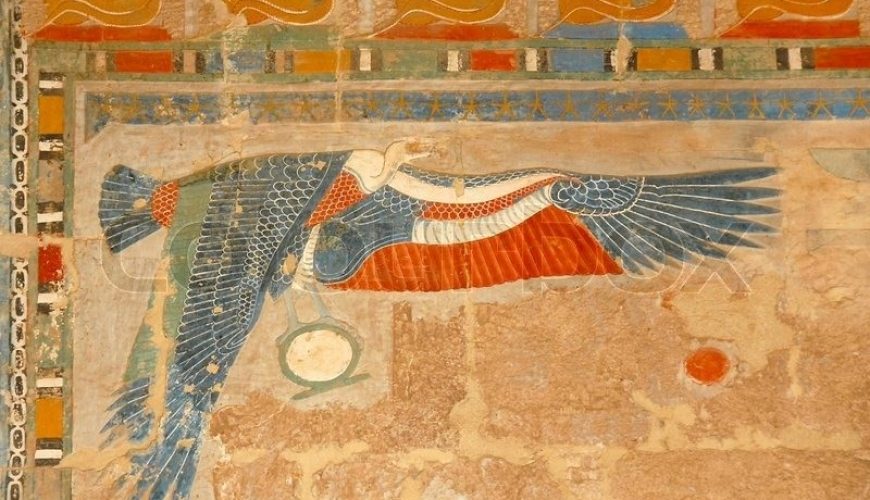
“Nakhebt” was known in ancient Egypt since the pre-families as a White Crown (Upper Egypt), a symbol of ancient Egyptian religion codes in the opposite era and the beginning of the era of families, and before the religious thought in ancient Egypt has turned into an era The fifth family to focus on the light system (Ra) in the universe and is reflected through the life cycle of the sun.
We slaughtered Egyptian art in the form of a female Eagle, and its holy city is the city of “Elites” (Cape 80 km south of Luxor on the eastern West Bank and corresponds to the West Bank city “Nahen” (Red Kom)
“Nakheb” originally is a goddess “The great house or the holy cabin, which the kings of Egypt crown, but the coming of the modern state,” he said, “Witnesses – Hakao” (great in magic) and is embodied by the supernatural powers of nature. He became a great housewife.
And “Nahen” (Red Kom) is where archaeologists found the famous Narmer panel and top of the scorpion king and are the discoveries of light on the beginnings of Egyptian art. On the palette, Narmer for a girl with excellence and century of cow is one of the oldest cosmic images in Egyptian art and described Madam al-Ahram. “Nakhb Ibb al-Ahram as a strong, strong sky, which is reflected in the image of a huge female.
Nakheb was associated with a special relationship with the King of Egypt, where Monday mentioned al-Ahram said that the king is in the sky and looking for it to be breastfed and revealing his spirit with the energy he needs after the end of his life on the ground and blowing a new life in the heavenly world.
The “Nakheb” was not limited to the female Eagle only, and since the Egyptian art also appeared in a cow.
(The Great Wild Cow, which is greeted in the city of “Elites” (Cape) … The white crown is the long-sleeved …
Described another text of Al-Ahram’s texts as the great wild cow greeted in the city of “toast” … with long hair and filled … It’s your breath, and will never miss you.”
This text confirms that the king never separates from the cosmic and is not survived and therefore still breastfeeds and never separates this breastfeed.
“Nakhbab” is an ecstasy that blows life, and at the same time is terrible, which is accompanied by life and blowing them to celestial crews, and returns and blowing them again in sequential cosmic courses.
And perhaps the face of the girl who appears above the painting of Narmer is the face of “named” that turned over time “Pat” and from Hathor.
He was attended by a great place in Egypt in the ancient state and the central state, but when the family of the family was in 18 countries, talking to the shadow, while the star of other rabies climbed.
We did not disappear, but it continued its appearance in the form of a female. His wings narrated eagle over the king to protect it, and also continued to be inhabited by her companion, “and said” the green, “and when they appeared on Monday, they are called the title of” My States “.
The “Nakheb” appeared above one of the Mukhtat Tutankhamun in the form of a female. The Egyptian artist filmed fourteen copies of nobility and is flying over the cabin’s ceiling—light in good.
The nature of the ancient Egyptian governorate does not allow them to be tired or neglected in a way that makes them fall from the collective awareness of the people.
In the coming of the era of the family 18, otherwise, including the Rabah (Death) in the compartment of Nakhbab, and the death of “deaths gained many of the qualities of naked and worshipped her tombs.
“Death” is also described as the awe of the hearts of its nationals as he does a female sight eagle when he is with the eyes and is the uniqueness of their wings in heaven.
But they were not in the same terrible and brutal tissue with long fly hair and the desperate chest.
Egyptian scientists describe death that it is the most disturbing ambiguity that is difficult to identify. It is characteristic that seems to contrast to “named” the majestic appeal of the brutal cow, which devours the lives and returns to a new life.
The King’s relationship with “naked” is not a human relationship and is a pure heavenly relationship, as described as al-Ahram. “I have no father among humans, and you are not a mother between humans … The king is a great life (and tight life), White crown, which dwells in “toast” (Cape).”
# Image of “Nakheb”, from Hatshepsut Temple – The monastery of the west of Luxor
Goddess Nakhebt of Ancient Egypt
July 30, 2021
0 comment

Comment (0)