




Egypt Magic [1592]
The Mariroca mastaba in Saqqara dates back to the beginning of the Sixth Dynasty. It is located 20 meters north of the pyramid of Tati, where Mariroca was one of the most senior officials of King Teti. Mariroca was a minister during the reign of the two kings Titi (2345 2323 BC) and Bibi I (2321 2287 BC).
As a minister and being the husband of the daughter of king Teti, Mariroca possessed great power and influence, a period in which the influence of the senior statesmen began to increase during the end of the Sixth Dynasty. Mariruka was buried in a cemetery in the shape of a terrace north of the pyramid of Titi in Saqqara, and it is considered one of the largest tombs of the king’s era.
It is also the most wonderful in terms of the scenes and decorations that adorn it among the tombs of the Old Kingdom (2686 2181 BC). The Mariroka tomb includes about thirty rooms that include five for his wife and five for his son, which are the rooms in which rituals for the souls of the deceased were held. The walls of the tomb include many interesting scenes that display
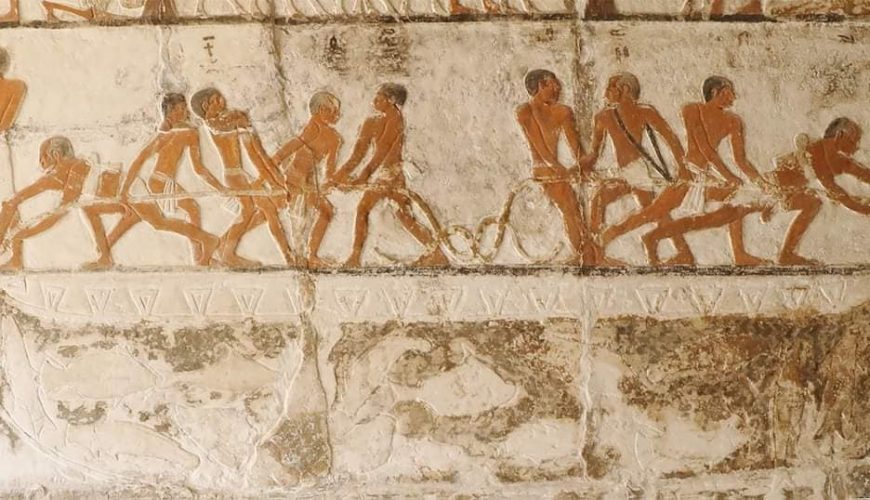
We have scenes of daily life during the Old Kingdom, such as grazing cattle in bushes, hippo hunting, scenes of hunting and birds, all of which appear in surprisingly vivid detail. We also see views of feeding animals; among the,m is the view of TG. Feeding the hayina a unique view of its kind, and from the wonderful and rare scenes, we see a scene that depicts an embodiment of the three seasons in the ancient Egyptian calendar, or the focal point of the tomb is what is known as the phantom door, and among the attractive points in the tomb is a life-size statue of Mariroka taking a step to receive the offerings presented to him on the offering table.
In front of the deceased are three seated gods representing the flood season (Akht) and the cultivation season (Burt), and the harvest season (Shamu), a scene that represents the delta jungles and the different birds living in it from the eggs and other birds standing on the lotus flower and the mongoose eats a small bird in its mouth a battle between
A hippo, a crocodile and another crocodile eat a small hippo when it is born; the sailors are in their boats as they cross with cattle. One of them is holding a small calf tied with a rope until the flock is pushed to cross the waterway easily as the calf’s mother will rush behind her little calf, and then the rest of the herd will follow her, carrying various offerings.
Utensils and carpentry work Gold making, jewellery and contracts, smelting and weighing metals Cultivation in the field Squeezing grapes and placing grapes in fishing sacks with different nets Salting the
A fish after being caught on a boat to preserve it A scene of catching caribou and deer between a lion and a bull and some hunting dogs biting the necks of ibex An inscription depicting the punishment of late paying taxes with sticks A view of a bed with a lion’s feet A view of his wife playing the harp in front of her husband a group of dancers and dancers and behind them clapping applauding the rhythm of the owner
The tomb and his wife play a game of checkers (chess). The sons and daughters of the deceased mourn and cry their father warmly. Finally, the imaginary door on the western wall and behind it is known as the basement where a statue of the deceased is placed. In this hall, the well leading to the burial room is a tomb that deserves careful consideration.

Comment (0)