


Egypt Magic [1415]
A wonderful tour inside The Royal Jewelry Museum in Alexandria, Egypt
The Royal Jewelry Museum is located in Alexandria. It occupies an area of 4,185 square meters. It contains the jewellery and ornaments that adorned the breasts of the princesses of the Egyptian royal families and the antiques that filled their palaces.
This museum was originally the palace of one of the princesses of the royal Alawite family. This palace was founded by Zainab Hanim Fahmy in 1919 AD, and she completed its construction and resided in it, her daughter Princess Fatima Al Zahraa in 1923 AD. The palace was used as a rest for the Presidency of the Republic until it was turned into a museum by a presidential decree in 1986 AD.
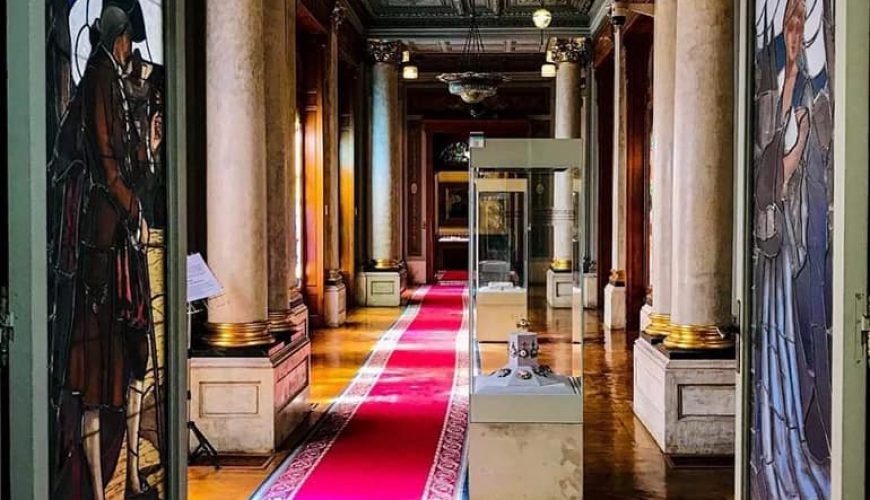
This museum (the palace) is located in the Zizinia area. This palace is a rare architectural masterpiece representing the European style in the nineteenth century; from the inside, the palace was decorated with distinctive artistic units.
The palace (the museum) consists of two wings: the eastern wing consists of two halls and a hall, topped by a bronze boy statue with a stained-glass painting, dovetailed with lead, and naturally decorated.
The Arab pavilion consists of two floors, the first has four halls, and the second is four, and connects the two wings of the palace with a very delicate hall. It is also rich in paintings representing ten doors of coloured glass and adorned with story drawings of European-style historical scenes and mythical stories such as Romeo and Juliet and mural paintings. Represents the marriage of her mansion.
The palace windows were decorated with artistic stained-glass panels, and the floor was covered with balsamic wood, roses and Turkish walnut.
The museum was restored and developed in 1986 and 1994. Since late 2004 AD, the Supreme Council of Antiquities began a comprehensive development and restoration process for the museum at an estimated cost of 10 million pounds to increase its capacity to accommodate more valuable exhibits in stores that were not displayed yet, and the museum was inaugurated in April. 2009.
Contents of the Royal Jewelry Museum:
The contents of this museum are old and date back to 1805 AD when Muhammad Ali Pasha assumed the throne of Egypt. After the July Revolution, 1952, these jewels were confiscated and placed in the treasuries of the General Administration of the recovered funds until the establishment of this museum, whose holdings are of very high material, artistic and historical value.
The museum includes 11 thousand and 500 pieces belonging to members of the royal family. The palace has been divided into ten halls containing collections of antiques and jewellery belonging to members of the royal families, who are the family of Muhammad Ali, and among these pieces is Prince Muhammad Ali Tawfiq’s collection, which includes 12 cups of platinum and gold. It contains 2,753 lobes of brilliant and flemish diamonds, a bag of gold studded with diamonds, in addition to a pocket watch of the Ottoman sultans and 6 cups of gold studded with 977 lobes of diamonds.
From the era of Khedive Said Pasha, we find a group of golden scarves and watches, in addition to Egyptian, Turkish and foreign medals and necklaces, which are encrusted with jewellery, pure gold, and ancient Coptic, Roman, Persian and Byzantine coins, numbering 4 thousand pieces.
One of the museum’s most beautiful collections is the golden Nachouq box studded with diamonds belonging to Muhammad Ali, the founder of the family, his chess, and his honourable sword, made of steel in the shape of a snake’s head.
The museum was also adorned with enamelled pictures in gold frames for Khedive Ismail, his wives, daughters and children. As for King Farouk’s group was characterized by the frequent use of diamonds in it and included his belongings. Inlaid with diamonds and rubies, one cup contains 229 rubies and 29 diamonds.
There is a section dedicated to gifts presented to King Farouk, including a set of gold tea that a group of Egyptian pashas gave to King Farouk and Queen Farida on their wedding day, and they signed their names behind the tray, as well as a special plate of agate given to him by the Tsar of Russia.
Because of the distinction of King Farouk’s collection, three halls were allocated to it in the museum. Perhaps the first thing that strikes the eye is the Princess’s Hall, the Crown of Princess Shweikar, which is one of the largest and most beautiful crowns of the jewellery of the Muhammad Ali family. At the same time, Queen Farida’s hall comes second after the hall of her husband, King Farouk. Gold and platinum, studded with 1506 diamonds, platinum and gold earrings studded after 136 diamonds, in addition to an impressive set of earrings studded with diamonds, rubies, aquamarines, emeralds and a full coral set.
As the collection of Princess Fawzia, the sister of King Farouk includes a platinum ring bearing Princess Fawzia, studded with brilliant, and a belt fork studded with more than 240 pieces of diamonds.
The museum includes other exhibits, including a royal watch encrusted with diamonds and an elephant-shaped masterpiece made of ivory inlaid with diamonds and rubies.
And a set of gold and platinum chest pins and a bowl of pure gold have been used with Queen Nariman since she opened a project.
In addition to the antiques donated by the heads of some European countries, including the famous Eugenie Chinese, which was given to Khedive Ismail at the opening of the Suez Canal, the value of which is estimated at more than 15 million pounds. From the history of Tsarist Russia, and no one knows how it entered Egypt.
As well as a coffee set decorated with 25 kilos of French silver, which the International Channel Company donated to Wali Muhammad Said Pasha.
This museum is one of Alexandria’s most beautiful tourist attractions, as it includes a rare and wonderful collection of antiques, jewellery, jewellery gold jewellery, precious stones, and watches studded with jewels and diamonds.

Comment (0)