
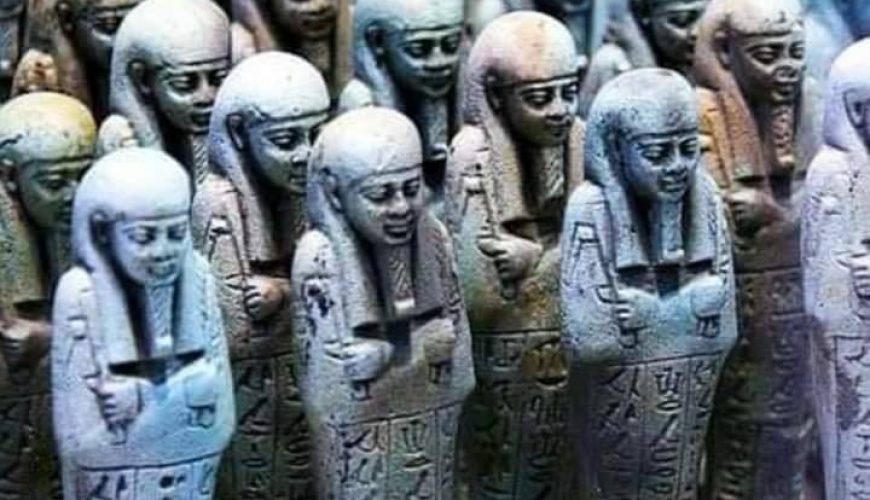
Ushabti
They are statues resembling mummies placed in ancient Egyptian tombs with features similar to the features of the deceased owner of the cemetery and were made of gold, stone, fiancé, wood or bronze, and sometimes of burnt clay according to the features to the richness of the deceased.
“The word ushabti is derived from the ancient Egyptian verb (washable) meaning to answer or to answer, hence the name ushabti statues meaning respondent.”
Religious texts were recorded on them at various stages in the history of ancient Egypt as a kind of symbolic service linked to the beliefs of the ancient Egyptians, starting from the Middle Kingdom. These statues were
You play the role of a farmer in the other world where there are fields
You need to plough and harvest just like the lower fields and live
in which are the righteous.”
The “respondents” began to be placed with the dead from kings, princes and great leaders, starting from the old state around 2600-2100 BC. They were in the form of life-size heads made of coloured limestone, and they were called alternative heads.
“And they kept being placed in the graves of the dead, but over time they took the shape of the whole body, but in the form of small statues. That is why these statues were sometimes depicted on their backs, wicker picks and an axe.”
Texts from the Book of the Dead that is recorded on statues also indicate this role. In the Middle Kingdom, they began to put a statue
One and then reached 366 and sometimes 400 statues during the era of the New Kingdom around 1470-1070 BC. m not only include a statue
One belongs to the cemetery owner, but statues similar to it are sufficient for the whole year. They also contain statues of scribes and presidents
and Osiris supervisors.”
In the later ages, large numbers of ushabti were found on wooden boxes, amounting to about 700 ushabtis. Fields like his flock.”
“The Ushabti were placed in boxes to preserve them, and they were placed in the tombs of kings and great leaders (Osiris) to serve you after that in the other world.”
“While the use of ushabti boxes was widespread in the tombs of Thebes (today’s Luxor), they were placed in flasks to preserve them in other cemeteries in the north or south of the country. Those flasks were coloured and written on them also, religious incantations from the Book of the Dead serve the deceased in the other world.
Ushabti
August 5, 2021
0 comment

Comment (0)